Pool Recording
The scores recording in the preferans is done in a special table called «the pool».
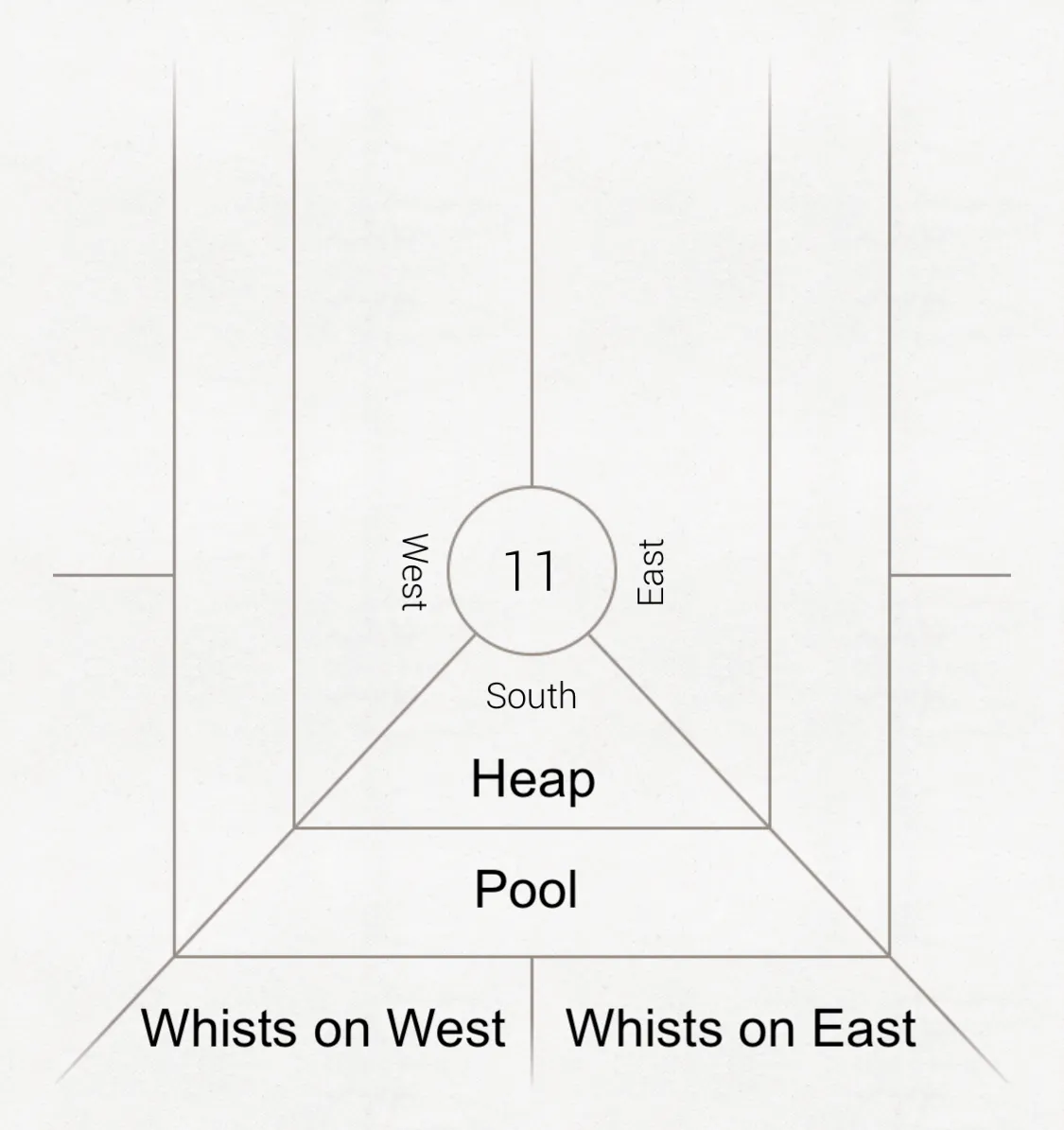
The table is divided by the current number of players, and each player's area is divided into several fields, namely:
Pool, not to confuse with table name, is used for recording winnings
Heap - all sorts of penalties go to heap
Whists - to record a direct debt on each of the players
Pool
Each contract in the game has its own price, and for the completion of the contract, the player receives points in the pool. The following recording is applied:
Completing six-hand game: 2 to pool
seven-handed: 4 to pool
eight-handed: 6 to pool
nine-handed: 8 to pool
ten-handed or misère: 10 to pool
No tricks taken on all-pass: 1 to pool (possible nuances, depending on the agreements)
Another option for getting pool points is the so-called «help» from an opponent. This help, however, is not free, and the player who is being helped to fill the pool must repay the debt in whists to the one who helps. Help is provided in the Sochi and Rostov conventions: if the current player has reached the maximum pool (that is, the goal of the game), then he must record all subsequent pool points earned to the player with the smallest pool, in exchange for a direct debt in whists - 10 whists for one pool point. In the Leningrad convention, no help is provided, the players simply continue to record a pool for themselves until the total pool is greater than or equal to the goal of the game multiplied by the number of players.
Heap
Penalties are recorded to heap for non-fulfillment of contracts - each non-taken trick results in a penalty with the price of the contract in Sochi and Rostov, and double the price of the contract in Leningrad. That is, for example, for five tricks in a six-handed game, the player receives (6 - 5) * 2 = 2 heap. For five tricks in a seven game, the player gets (7 - 5) * 4 = 8 heap. Each trick on the misère results in 10 heap, so the misère must be ordered and played very carefully. In the conventions of Sochi and Leningrad for each trick on passes, one point is recorded to the heap multiplied by the current progression of all-pass round.
A whisted player may receive a heap scores if he does not take the number of tricks required for the game: four tricks for a six game, two for a seven game, one trick for an eight and nine game. Misère and ten game do not oblige whisted players to take any tricks. Heap points are recorded as the cost of the contract for each non-taken trick.
Additionaly, heap points are recorded in regards, which are not directly related to the deal. Incorrect delivery of cards, a move not according to the rules (a move not in a suit or in a trump card while having of a move suit), a move out of turn - all this is punished by two or more heap points. More serious offences, such as repeated violations of the rules or deliberate attempts to cheat, are punished much more severely - from 10 heap points and more.
Whists
A direct debt to the opponent is recorded to whists. Whists are recorded for tricks taken against a player who is trying to fulfill a contract, and the quantity of whists depends on the price of the contract. Recording whists is the most confusing part of recording a pool, as many factors must be taken into account: only whisting players write whists, but if the whist is declared as gentleman's, then gained whists are divided in half. Additional whists are provided for consolidating - if a player has not fulfilled the contract, then all players, even those not participating in the deal, receive additional whists.
Each trick taken by the whisted players or not collected by the contract player is converted into the cost of the contract in whists. Whist scores are not recorded in misère game. That is, an unplayed six-game game without three tricks when playing with four players will cost the player:
6 - direct whists (3 untaken tricks * 2 contract price)
18 - consolation (3 defenders * 3 untaken tricks * 2 contract price)
Total -24 whists of direct debt
This is a big loss, and there are still 6 heap points, which give another -45 whists (more on the calculations in the next section), a total of -69 whists is quite a lot.
In the Rostov convention, whists are written for all-pass rounds - the one who has collected the least number of tricks on writes 5 whists for each trick won against each opponent. If there are two winners (for example, with tricks distribution 3-3-4), then the whists on the loser are divided in half
Pool calculation will be discussed in the next section.