Scores sum
zero
Preferans is a zero-sum game: whatever one player wins, the rest lose in total, after every deal.
Pool Calculation
The calculation of a pool in preferans can be split into following stages:
Amnesty
Pool and heap
Direct whists
Rounding
Practice and examples of pool calculations for three (Sochi), four (Leningrad) and two (Sochi) players are given at the end of the section But first, a bit of theory.
A bit of theory
Preferans is a zero-sum game, that is, the sum of the scores of all players must always be equal to zero, and the payoffs of all players are opposite. This is true for any pool state, mid game or end game. Thus, if scores are added to one player, then exactly the same number of scores is subtracted from the rest of the players. This is why SmartPref can calculate rating separately after every deal.
How it works?
Before the start of the game, the players agree on a convention - Leningrad, Sochi or Rostov, as well as how much one whist point costs in currency. For calculations, the rate of a pool and a heap points to whist points matters: in Leningrad, a pool point costs 20 whists, a heap point costs 10. In other conventions, a pool and a heap points cost 10 whists each, so Leningrad is considered a more dynamic convention, it’s more profitable to take risks here.
When crediting a player with a pool point, he receives the agreed number of whists, but since the amount must be zero, then each player must pay these whists in equal shares, including the player who received the pool point. Similarly with the heap - when getting a heap point the player gives all players the agreed number of whists in equal shares, including self.
If you play 3 player Leningrad and get 2 in a heap by playing a six game (both defenders folded, which saves you from direct whists), then your net income from this game is 2 * 20 - (2 * 20) / 3 = 26.66 whists
(2 pool * 20 whists) / 3 players = 13.33 whists - expense, contribution to the total payout to you.
Total: 40 - 13.33 = 26.66
Thus, your opponents owe -(2 * 20)/3 = -13.33 whist each, this is their contribution to the total payout.
One more example. You play the first round of all-pass in Sochi, three players, and the tricks are distributed as follows: 3-3-4, where you took 4. Thus, your opponents got 3 heap, you 4. After the amnesty, only 1 remains in your heap. Your total loss is -(1 * 10) + (1 * 10)/3 = -6.66 whists
(1 heap * 10 whists) / 3 players = 3.33 whists - your income from the total payout
Total: -10 + 3.33 = -6.66
Your opponents received (1 * 10)/3 = 3.33 whist each.
So we're ready to compute the pool
Amnesty
It all starts with an amnesty. You simply subtract the smallest pool among the players from all players (or, depending on the recording type, if the pool is the same for everyone, just write it off). Similarly, the heap is amnestied - the smallest heap among the players is subtracted from the rest, or added if the heap turned out to be negative by the end of the game. Amnesty is needed only to simplify the calculations and does not affect the final score.
Pool and heap
Pool and heap are calculated separately for each player. The order does not matter, but it is important to record the total of each player in each calculation, so that you can then add the resulting values. This will be a subtotal for the pool and the heap. The result should be a table where for each player his result and the results of his opponents will be recorded. For three players, you get 9 values, which you need to add up for each player separately to get a subtotal. To check, you can sum all the intermediate values together, resulting value should be zero.
Calculation examples are given at the end of the section.
Direct whists
It is simple, direct whists are the direct debt of the player to whom they are recorded. If you wrote down 42 whists for a player, and he wrote 23 for you, then the total will be 42 - 23 = 19 whists the player owes you, they go to your income, and to him - to expenses.
Rounding
It often turns out that the final whists of the players are fractional, and if the game is played on indivisible objects, for example, matches, shells or ships, then it is necessary to round them correctly. Whists are rounded only at the very end of the calculation, otherwise incorrect rounding may slightly distort the result. Negative and positive whists are rounded the same way - to the nearest whole; half can be rounded up or down in absolute value, but it is important that all values are rounded according to the same rule. Example
12.2 = 12; -12.2 = -12;
12.5 = 12 or 13; -12.5 = -12 or -13;
12.7 = 13; -12.7 = -13;
Practice
An example of calculating a pool for three players (Sochi)
Pool and heap
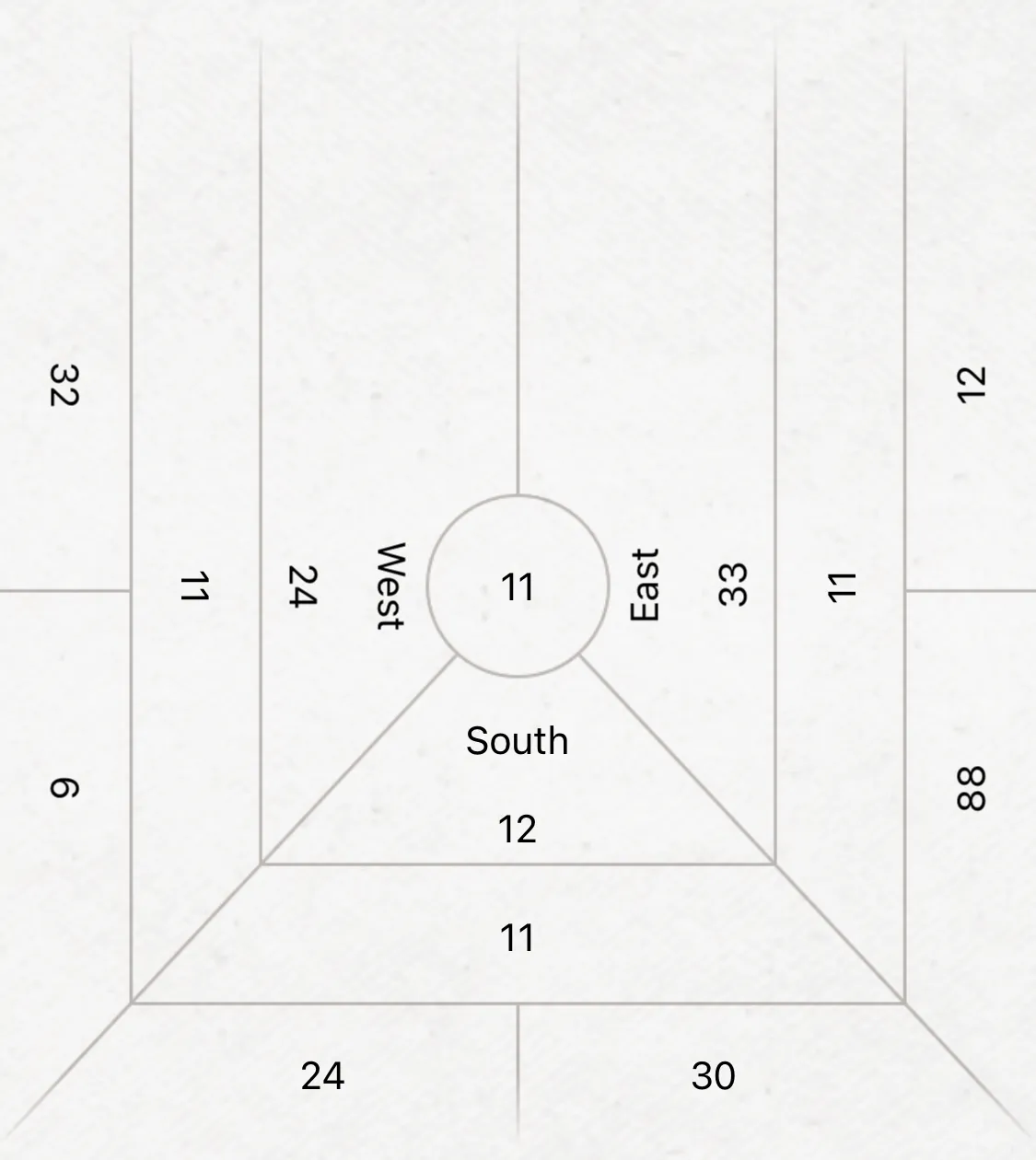
South - after applying the amnesty, the pool and the heap for the South are reset to zero, since the pool is the same for all players, and the heap is the smallest of all three players. In total, the pool and the heap add up to 0 whists in the subtotal. We will calculate direct whists later, but for now the subtotal of the South is zero whists.
West - after amnesty pool: 0, heap: 24 - 12 (from South) = 12 points in heap. According to the convention, one heap point is equal to 10 whists. Thus, the West owes everyone 120 whists, of which they get back 120/3 = 40 (3 in this case is the number of players to which the whists are distributed. A reminder that the West itself is also included). South and East get the remainder - 120/3 = 40 whists each. West subtotal -120 + 40 = -80 whists.
East - after amnesty pool: 0, heap: 33 - 12 (from South) = 21 points in heap. East must give 210 whists, of which 210/3 = 70 are returned. South and West receive 210/3 = 70 whists each. East subtotal -210 + 70 = -140 whists.
Let's sum up the calculation of a pool and a heap
South: 0 (from self) + 40 (from West) + 70 (from East) = 110 whists
West: -120 (debt to all) + 40 (from self) + 70 (from East) = -10 whists
East: -210 (debt to all) + 70 (from self) + 40 (from West) = -100 whists
Direct whists
South owes West 24 and West owes South 6, so the balance of South to the West is 24 - 6 = 18. Things are a little worse on the East side - South owes East 88 whists, and can take only 30, total 30 - 88 = -58 - the balance of the South to the East.
West owes South 18 whists, we have already calculated this. West to East has 32 whists and 12 dues, so the balance of West to East is 32 - 12 = 20 whists
East takes 58 whists from the South and must give the West 20 - we just calculated all this.
Thus, the balance of direct whists is
South 18 (takes from West) - 58 (gives to East) = -40
West -18 (gives to South) + 20 (takes from East) = 2
East 58 (takes from South) - 20 (gives to East) = 38
Grand total
Since rounding is not required, to complete calculations it is enough to add scores up
South 110 - 40 = 70
West -10 + 2 = -8
East -100 + 38 = -62
As expected, the sum of the points again gives us zero, the points are calculated correctly and the bill can now be settled.
An example of calculating a pool for four players (Leningrad)
Pool and heap
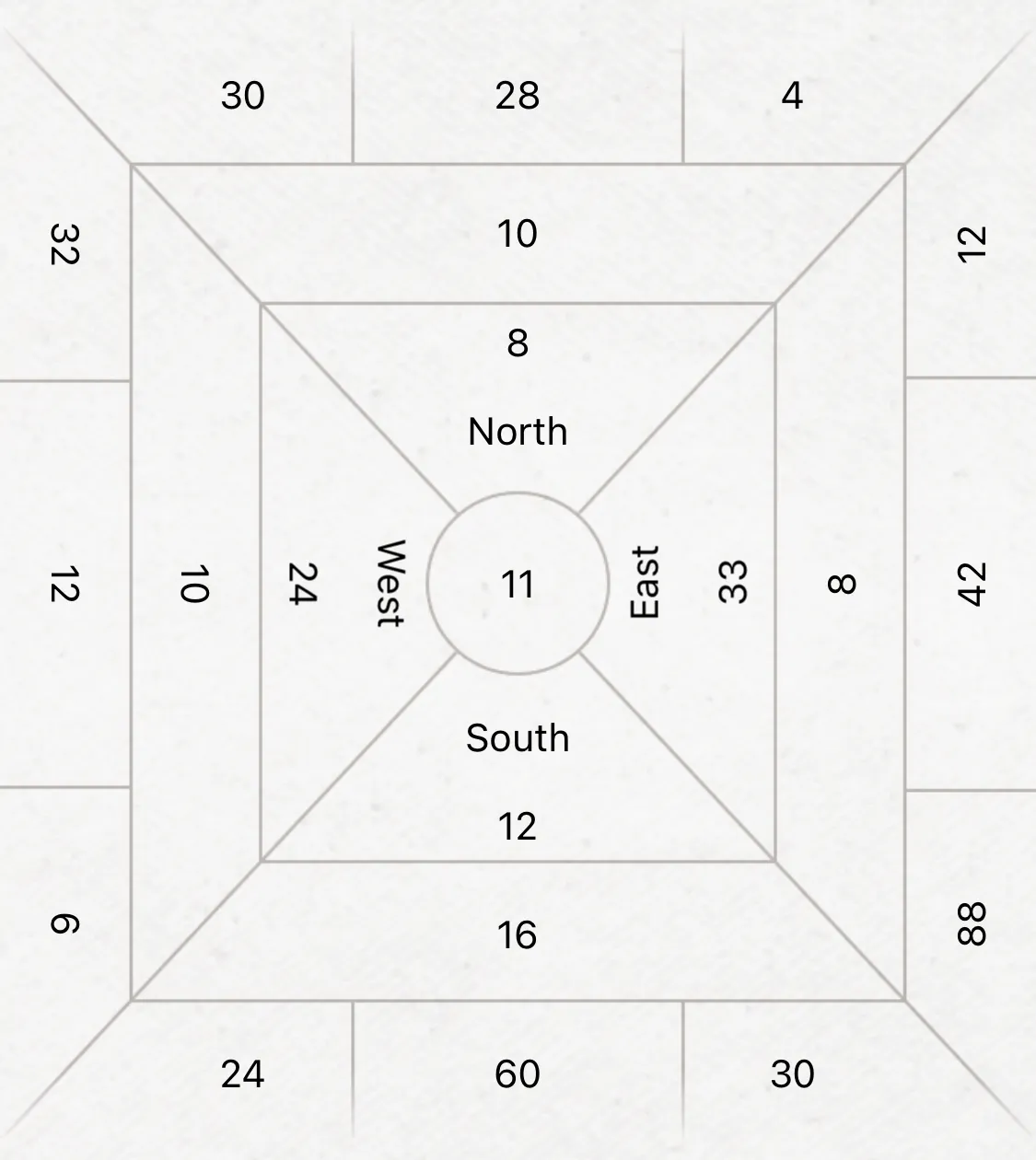
South - after applying the amnesty, the pool becomes 16 - 8 (the smallest pool is East) = 8, and the heap 12 - 8 (the smallest heap in North) = 4. According to the convention, one pool point is equal to 20 whists. Thus South gets 8 * 20 = 160 whists. Now all players owe 8 * 20 / 4 (number of players) = 40 whists each, including South, so South gets 160 - 40 = 120 whists for pool. Now the heap - a heap point costs 10 whists. That is, South owes 4 * 10 = 40 whists. All players, including South, receive 40 / 4 = 10 whists. The result of South is -40 + 10 = -30 whists from the heap. Total of South is 120 - 30 = 90 whists
West - after amnesty pool: 10 - 8 (from East) = 2, heap: 24 - 8 (from North) = 16 points in heap. Thus West gets 2 * 20 = 40 whists. Now all players owe 2 * 20 / 4 = 10 whists each, including West, meaning West gets 40 - 10 = 30 whists for pool. Heap: West owes 16 * 10 = 160 whists. All players, including the West, receive 160 / 4 = 40 whists. West subtotal is -160 + 40 = -120 whists for a heap. West total is 30 - 120 = -90 whists
North - after the amnesty pool is 10 - 8 (from East) = 2; since the heap is minimal after the amnesty it is reduced to zero. So North gets 2 * 20 = 40 whists from pool. All players owe 2 * 20 / 4 = 10 whists each, including North, so as a total North receives 40 - 10 = 30 whists for a pool. Since the heap has been reset to zero, this concludes computations for North
East - after the amnesty, the pool is reset to zero, the heap is 33 - 8 (from North) = 25 points. Thus, East gets nothing from the pool. Heap: East owes 25 * 10 = 250 whists. All players, including East, receive 250 / 4 = 62.5 whists. East subtotal is -250 + 62.5 = -187.5 whists from heap. Since the pool is zeroed out, this concludes computations for East
Let's sum up the calculation of a pool and a heap
South 90 (own total) + (40 - 10) (from West) + -10 (from North) + 62.5 (from East) = 172.5 whists
West -90 (own total) + (10 - 40) (from South) + -10 (from North) + 62.5 (from East) = -67.5 whists
North 30 (own total) + (10 - 40) (from South) + (40 - 10) (from West) + 62.5 (from East) = 92.5 whists< br/>
East -187.5 (own total) + (10 - 40) (from South) + -10 (from North) + (40 - 10) (from West) = -197.5 whist
Direct whists
South owes West 24, and West owes South 6, so the balance in favor of the South is 24 - 6 = 18. The balance of the South with the North is 60 - 28 = 32 in favor of the South. Things are a little worse on the East - the South owes East 88 whists, and can only take 30, total 30 - 88 = -58 - the balance of the South with East side.
The West owes South 18 whists, we have already calculated this. West to East - 12 whists and 42 dues, that is, the balance of West to East is 12 - 42 = -30 whists. West to North has 32 - 30 = 2 whist.
North owes South 32 whists and 2 to West - this is what we just calculated. Balance of North with East 12 - 4 = 8 whists North owes East.
East counted in the previous three calculations, let's write them down: East takes 58 whists from South, 30 from West and 8 from North.
Thus, the balance of direct whists is
South 18 (takes from West) + 32 (takes from North) - 58 (owes East) = -8
West -18 (owes South) +2 (takes from North) - 30 (owes East) = -46
North -32 (owes South) -2 (owes West) -8 (owes East) = -42
East 58 (takes from South) + 30 (takes from West) + 8 (takes from North) = 96
Grand total and rounding
Let's sum up and round the points to the nearest whole number (to the smallest modulo, if you rounding half the whist)
South 172.5 - 8 = 164.5, or 164 after rounding
West -67.5 -46 = -113.5 or -113 after rounding
North 92.5 - 42 = 50.5 or 50 after rounding
East -197.5 + 96 = -101.5 or -101 after rounding
As expected, the sum of points before and after rounding again gives us zero, the points are calculated correctly and the bill can be settled.
An example of calculating a pool for two players (Sochi)
Pool and heap
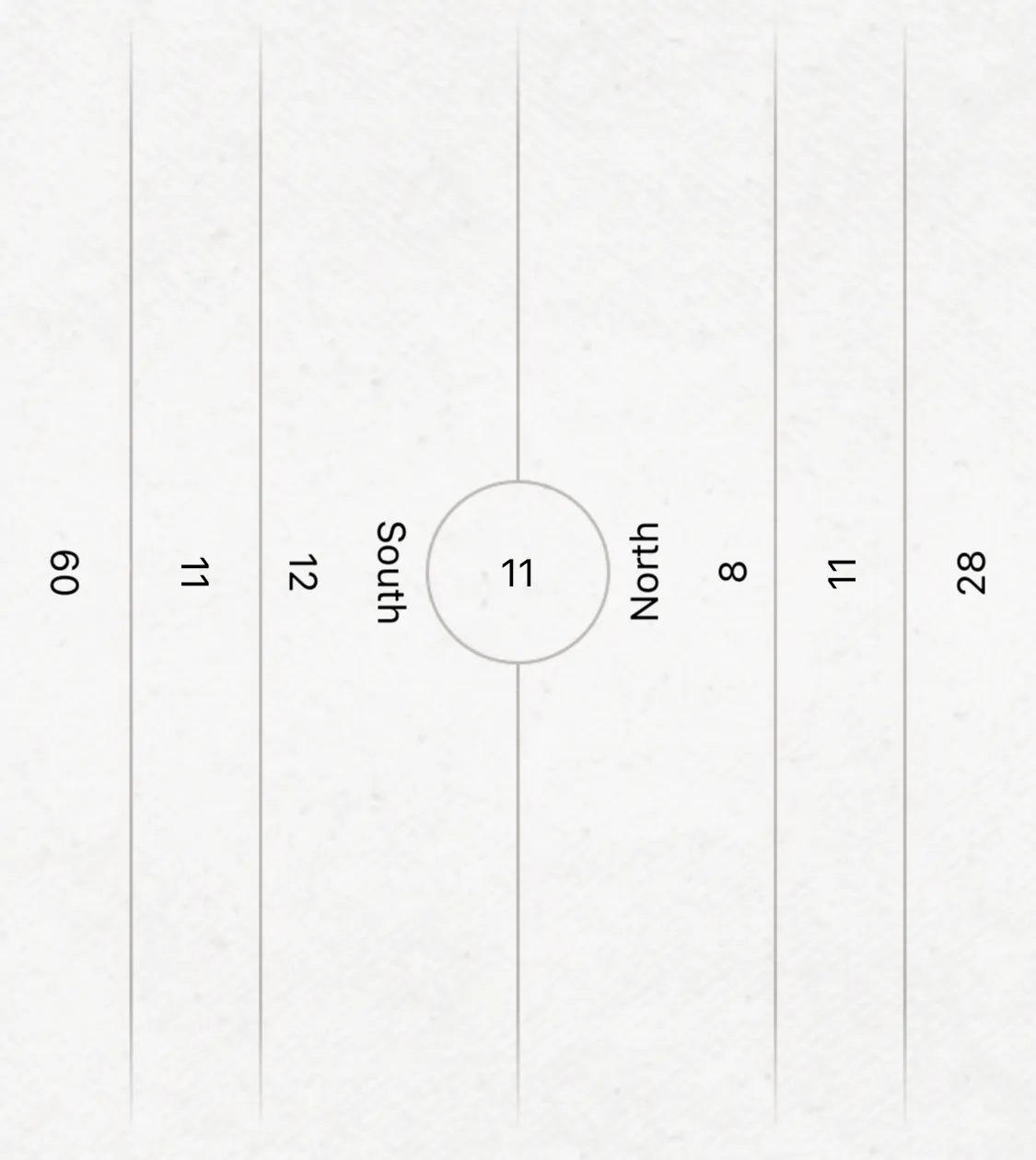
South - after applying the amnesty, the pool becomes 0 (the pool is the same for everyone), and the heap is 12 - 8 (the smallest heap in North) = 4. According to the convention, a heap point is worth 10 whists. That is, South owes 4 * 10 = 40 whists. All players, including South, receive 40 / 2 (two players in the game) = 20 whists. The result of South is -40 + 20 = -20 whists from the heap. This is the subtotal of South
North - after the amnesty pool is 0, heap is 0, since the heap of North is minimal. Thus North subtotal is 0 whists.
Let's sum up the calculation of a pool and a heap
South: -20 (from self) = -20 whists
North: 20 (from South) = 20 whists
Direct whists
South owes North 28, and North owes South 60, so the balance in favor of South is 60 - 28 = 32.
North, respectively, should give 32 whists to the South, as we just calculated.
Thus, the balance of direct whists is
South = 32
North = -32
Grand total
No rounding is required, we can just summarize the scores
South -20 + 32 = 12
North 20 - 32 = -12
As expected, the sum of points again gives us zero, the points are calculated correctly and the bill can be settled.